Leasing operations software

Your portfolio lives in a spreadsheet. The detail lives on your team's phones. The decisions get made from memory.

Leaseline reads the rent roll you already keep and puts one register, one set of templates, one approval chain and one live management view around it.

Runs onThe rent roll you have
ReplacesNothing you already run
Built forRetail & mixed-use
Walkthrough

See Leaseline in use

The gap

What a spreadsheet quietly costs

Every one of these came out of a real rent roll.

Leases with no expiry

Invisible to every report. No contractual protection, and nobody is diarising them.

Renewals started late

Leverage falls the closer you get to expiry. The tenant knows the date too.

Billing drift

Agreed step-ups that never reached the invoice. Nobody reconciles the two.

No live management view

Occupancy, WALE and income concentration rebuilt by hand each month, out of date on arrival.

Key-person risk

When the person who knows the portfolio leaves, the knowledge leaves with them.

What it's worth

Three places this shows up on the numbers

Rent you would otherwise give away. Exposure you would not have seen. Weeks of a leasing team's year.

Income

20 / 150
Tenants below their category's healthy band

A renewal opened nine months out is a negotiation. Opened six weeks out, it is a request. Occupancy cost shows which tenants can absorb an increase and which are already at the edge.

Risk

RM5.01m
Annualised rent sitting in holdover

A lease with no recorded expiry appears in no report and protects nothing. At portfolio scale the same problem is expiry concentration — one quarter carrying a third of your income.

Control and time

4 inputs
From the executive to a complete Letter of Offer

One register, one approval chain, a recorded approver on every offer. The monthly pack stops being assembled by hand, because the numbers are already computed.

Figures from the demonstration portfolio below — 150 leases of fictional data, built to behave like a real rent roll. They are what the system found in it, not results claimed on anyone's behalf. What it finds in yours is the only number that matters, and it takes one export to know.

What it does

Every screen below is the working system

Running on a fictional mall of 150 leases, built to look like a real rent roll — mess included.

01

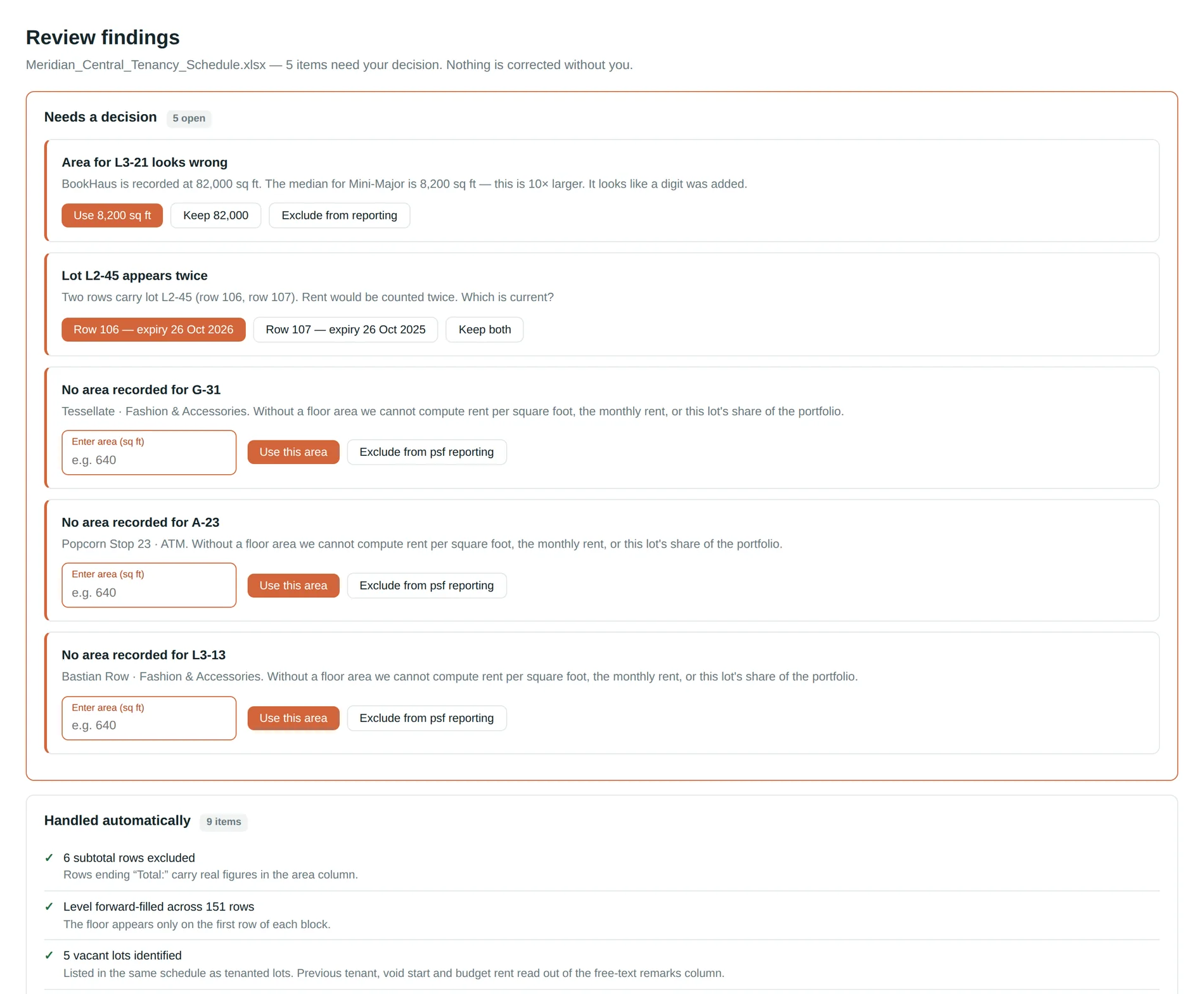
It tells you what's wrong before it builds anything

Every import is checked. What can be resolved without guessing is resolved and logged; everything else is put to a person with the evidence and the options in front of them. It reads any layout, matching your columns on both their wording and their contents.

Why it mattersA register that looks right and is wrong is worse than no register. Nothing is silently corrected, and your file is never modified.
Review findings screen listing data problems with resolution options for each
Five items needing a human decision, and nine resolved automatically with the reasoning logged.
02

Nothing expires unnoticed

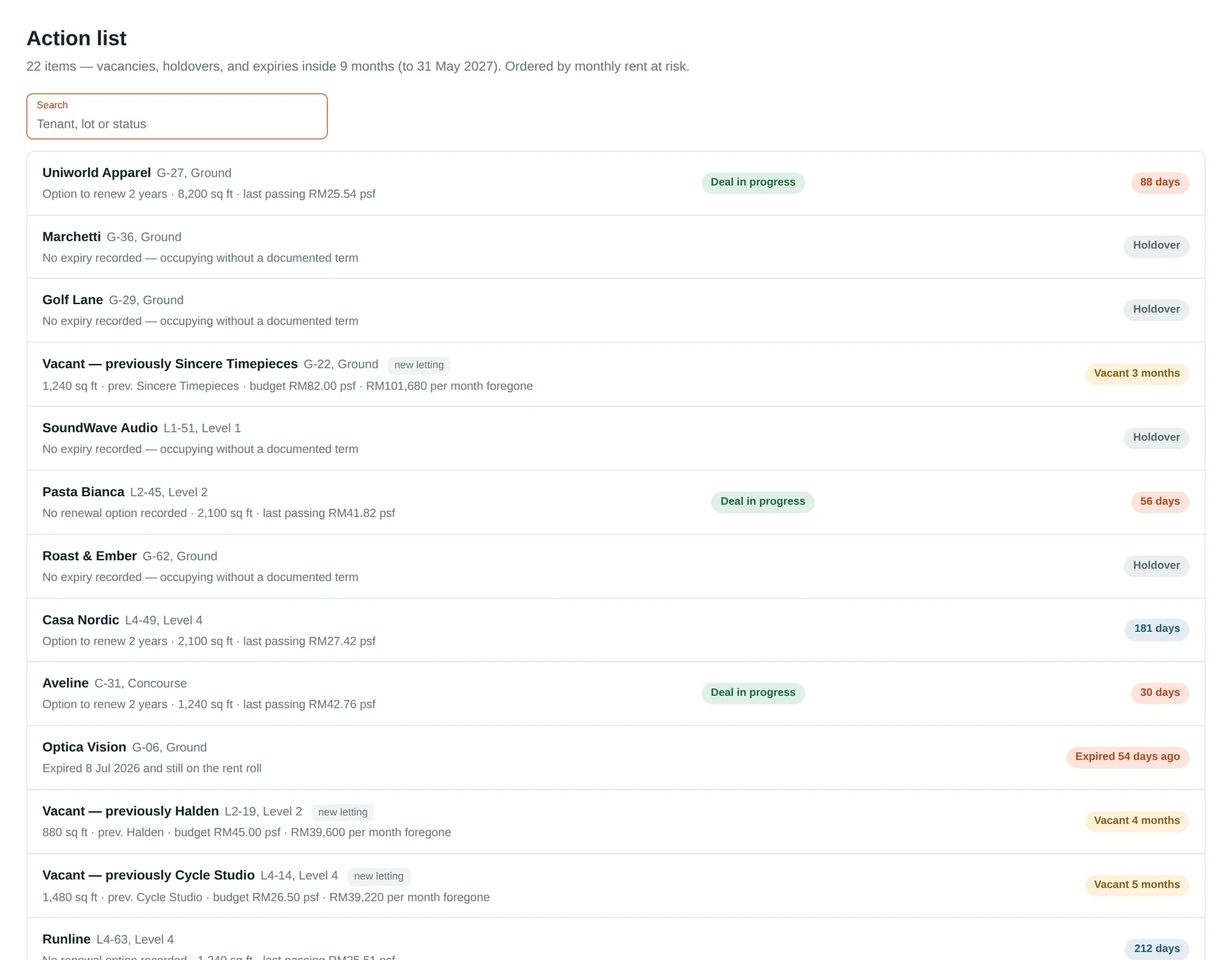
Expiries inside your notice window, leases already past expiry, holdovers with no documented term, vacant units priced at rent forgone — ranked by monthly rent at risk, so the list leads with money rather than with dates.

Why it mattersOn this portfolio one lease expired 54 days ago and is still on the rent roll, collecting at a rate nobody has renegotiated.
Action list ranked by monthly rent at risk
Eighteen items, ordered by exposure rather than by date.
03

See the cliff before you build it

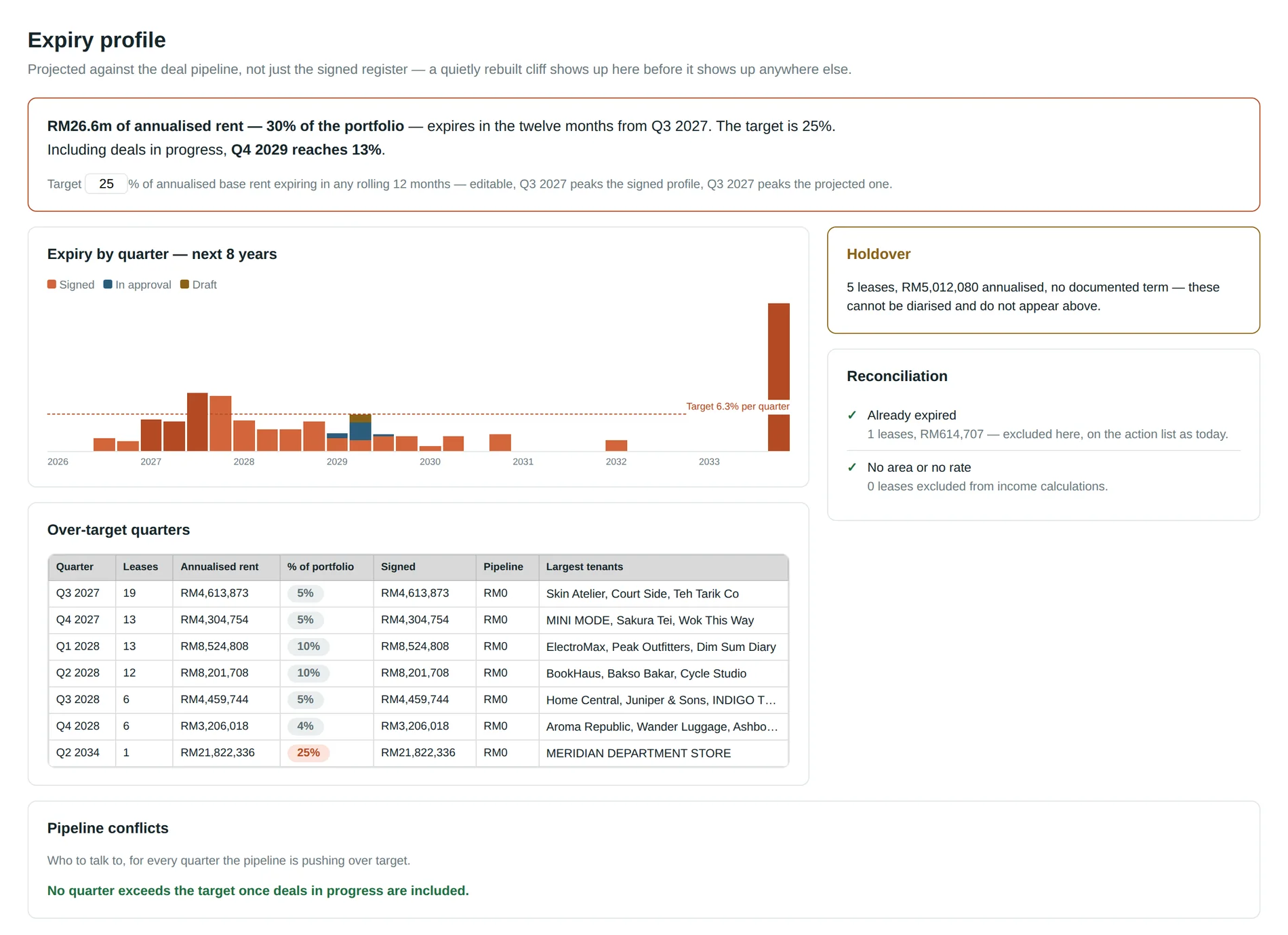
A mall that opens at once expires at once. The renewals signed this quarter either repeat that cliff in three years or break it — and breaking it means varying term lengths deliberately, while the whole cycle is still open. Projected against deals in progress, not just the signed register.

Why it mattersConcentration is a valuation input. Four executives each choosing a sensible three-year term can rebuild a cliff that none of them can see.
Expiry profile by quarter against a concentration target, with pipeline conflicts
RM26.6m — 30% of portfolio income — falling into a single twelve-month window against a 25% target.
04

Rent as a share of turnover

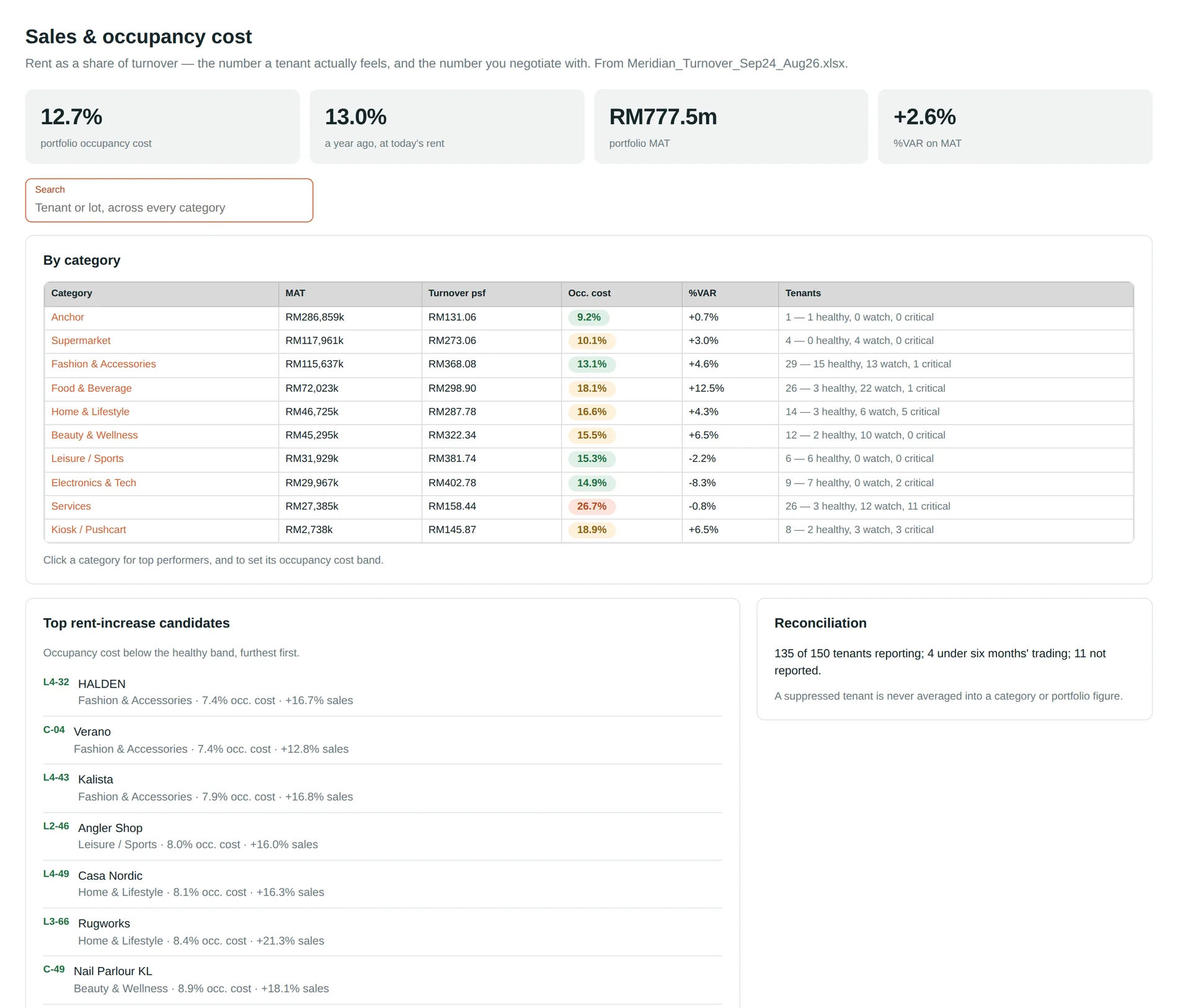
Import monthly sales and every renewal conversation gains a floor under it: occupancy cost on moving annual turnover, per tenant and per category, beside turnover per square foot. A tenant at 12% can absorb an increase. A tenant at 28% is heading for a default, and pushing rent is how you get a void to re-let.

Why it mattersThe difference between a rent review argued from evidence and one argued from last year's number plus a percentage.
Sales and occupancy cost by category with rent-increase candidates and renewal risks
Portfolio at 12.7%; Services running at 26.7% with eleven tenants in the critical band.
05

One register, and every figure traces back

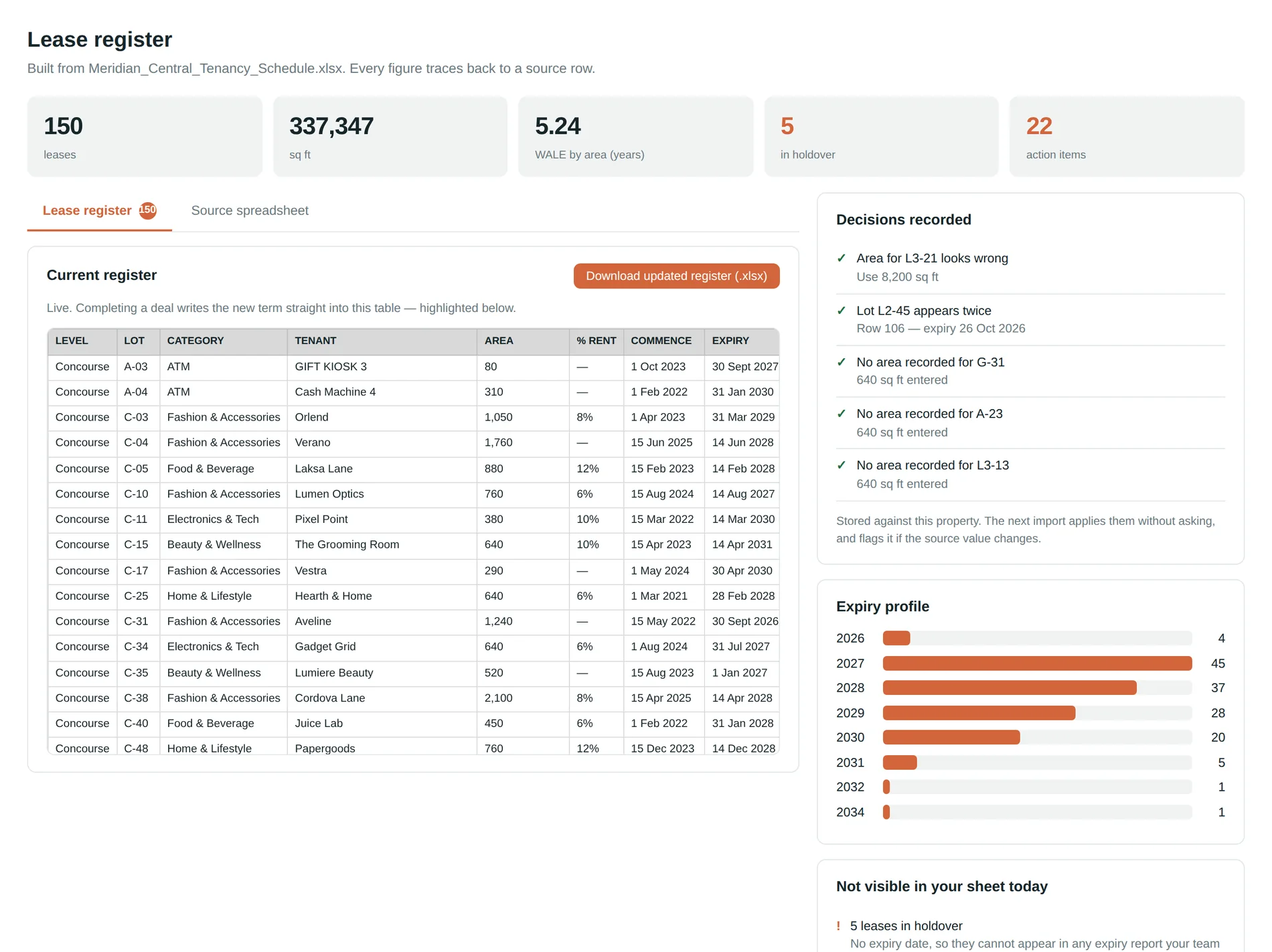
Every lease structured — dates, areas, step-ups, service charge, percentage rent — with a route from any number on screen back to the row it came from. Completing a deal writes the new term straight back, so the master file and the system never diverge.

Why it mattersWhen the person who knows the portfolio leaves, the portfolio stays behind.
Lease register with every lease structured and traceable to its source row
150 leases, 337,347 sq ft, WALE of 5.24 years — computed, not maintained.
06

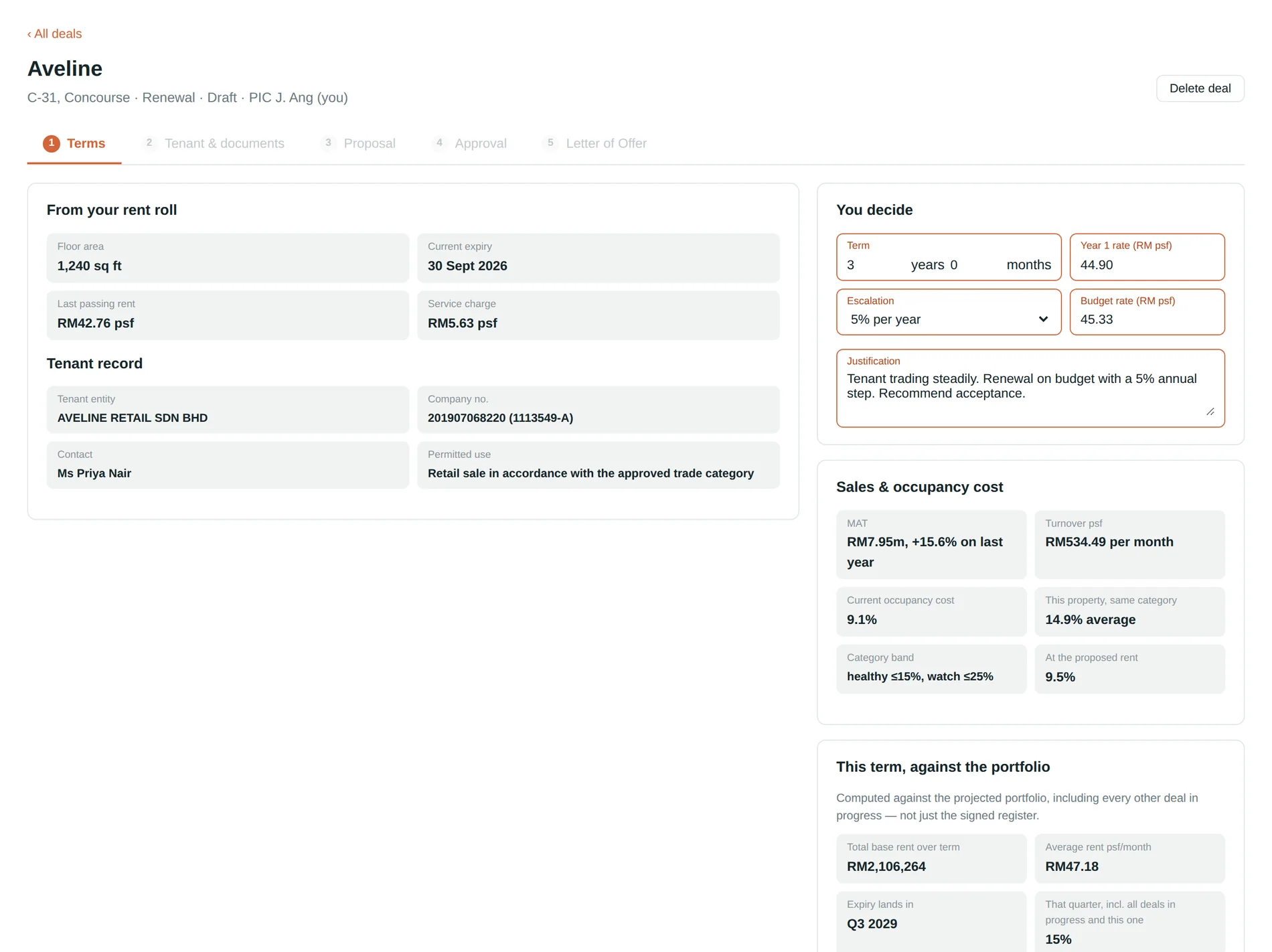
Four inputs. Everything else is already known.

Terms, tenant record, proposal, approval, offer. The chain is built upward from whoever prepared the deal, so nobody approves their own, and a rejection returns the file with comments rather than disappearing into an inbox. Documents generate into your own Word templates — clauses, formatting and running header untouched.

Why it mattersEvery offer that leaves the building has a recorded approver, a version and a date. That is the difference between a process and a habit.
Deal workspace showing agreed terms alongside the derived approval chain
Proposed against budget, year by year, with the chain derived from the preparer's level.
For management

Live, and only for the roles you choose

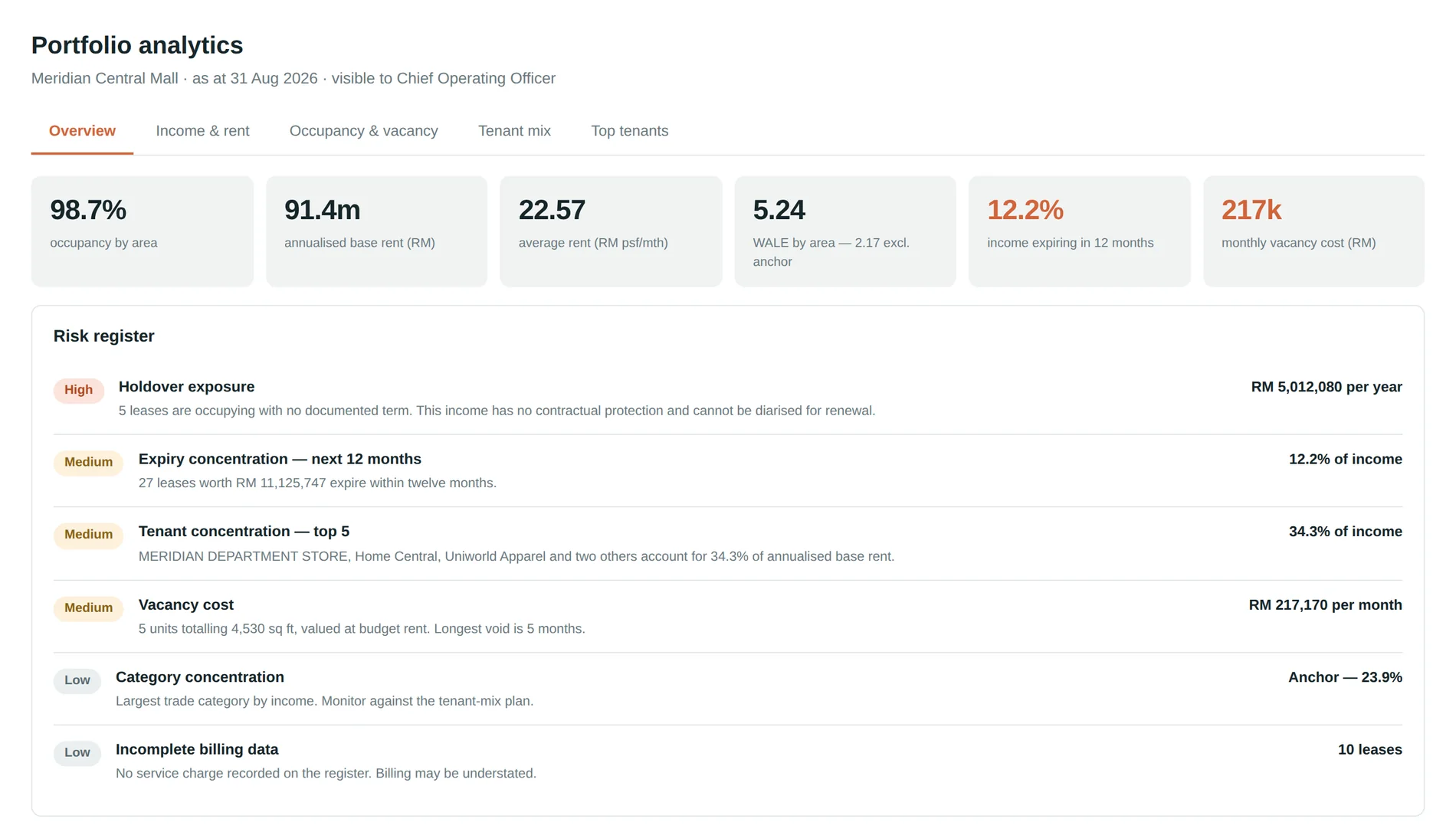
Occupancy, annualised rent, WALE, expiry and tenant concentration, vacancy cost — computed from the register rather than rebuilt by hand for each month's pack. Income and risk exposure are commercially sensitive, so access is set per role during configuration.

Portfolio analytics with risk register, expiry profile and income by category
Seen by the Chief Operating Officer.
The same screen refused to a leasing executive
The same screen, seen by a leasing executive.
Who it's for

Portfolios run by people, not by platforms

The tools available to a leasing team are either enterprise systems that take six months and six figures to deploy, or a spreadsheet and a folder of Word documents. This is the layer in between.

Shopping malls

A hundred to four hundred tenancies, a small leasing team, and a renewal cycle that arrives all at once.

Mixed-use developments

Retail podiums where leasing sits inside a larger development business and has no system of its own.

Developers with several assets

One view across the portfolio, and one way of doing things across teams that were never standardised.

REITs and asset managers

WALE and expiry profile are a quarterly reporting obligation, not a convenience. Produced from the register rather than assembled by hand.

Managing agents

Running assets on behalf of owners, judged on leasing performance, and carrying the reporting burden for every one of them.

Teams already on SharePoint

Your files stay where they are. No migration, and nothing new for the team to log into every day.

The obvious question

“We already use Copilot for this”

General AI drafts quickly and makes each person faster. It cannot enforce which template version was used, check the figures against your rent roll, stop an offer being issued before approval, or record who approved what and on which version.

Six people generating documents six different ways creates more uncontrolled copies of your commercial terms, not fewer. Leaseline generates from one register, through one approval chain, and files the result back where it belongs.

About

Built from inside the industry, not from outside it

We are a small team. Between us we carry decades of running retail leasing inside major Malaysian shopping centres — negotiating the renewals, chasing the approvals, rebuilding the monthly pack by hand — and years more building and operating businesses where the reporting had to work before anything else could.

That is where the product comes from. What belongs on an action list and what is noise. Which tenant is worth a longer term and which one you keep your options on. What occupancy cost means for a café as against a jeweller. Which numbers a system has no business guessing at, and should say so instead.

The software was the straightforward part. Knowing what to build took the years inside it — and it is why Leaseline does a few things properly rather than everything approximately.

We are working with a small number of design partners ahead of general availability. If you run a retail or mixed-use portfolio and the screens above look like your week, we would like to hear from you.
Get in touch

See it on your own rent roll

The fastest way to judge this is to watch it read your own data. Send one export and we will show you what it finds in it — including the parts you would rather it didn't.

josh@getleaseline.com
+60 12 611 8525  ·  Kuala Lumpur, Malaysia